Lee” has a myriad of meanings these days – alleys, blue-eyed girls, a brand of jeans. It was a type of medium tank in World War II. And it is a common first and last name over much of the world.
In the sailing world, “lee” has only one connotation – toward or on the downwind side of the boat. Ergo, “leeward” is the opposite of “windward.”
The word is thought to have originated from and Old Saxon (and French, and Norse) word meaning, literally, “shelter.”
Your right - this really has nothing to do with the story!
In the old days, the word was often used as “alee” - the “a” being an Old English preposition indicating “toward”, “on”, “in”, “into” or “to.” It's still occasionally heard as “helm's alee” during a tack, but otherwise “alee” has fallen into disuse. There are other nautical words that still use the “a” construct, such as “aweigh” and “ashore.” And lots of non-nautical ones - ablaze, astride, awry, afar, aloud, etc.
If you're on a run, sailing “by the lee” means sailing downwind past the point where you normally would have jibed. To say it another way, the wind has 'crossed' astern and is now coming over the other side. So if you're on a port jibe with the main out to starboard, and you turn past DDW and the wind is now coming over the starboard side, you are “by the lee.” This can be a dangerous situation on most boats, since it can cause an abrupt jibe if the wind gets behind the main. However, many racers, especially dinghy sailors, purposely sail by the lee because it's faster.
“Lee helm” indicates you have to push a tiller (or turn a wheel) to leeward to keep a vessel tracking correctly. This is usually a trim issue that can – and should be – corrected by adjusting the sail configuration or the rig. (Normally, a sailing vessel will want a bit of weather helm, so that if you let go of the steering, the boat will round up and spill wind, rather than – with lee helm - head down and make things more exciting than they need to be.)
“Leeway” may see more use in the mainstream lexicon these days (connotating “wiggle room”), but its origins are in sailing. Leeway is how much a boat deviates to leeward from a desired straight course. All sailboats make a bit of leeway simply from the force of the wind blowing at them sideways. How much depends on several factors. Keels and centerboards minimize leeway. If you ever want to see leeway in action, take the centerboard out of a dinghy and try to sail to weather.
To some, the most confusing use of “lee” is the concept of “lee shore.” This may be because, with the advent of engines, few sailors worry much about it any more. But in the old days, a lee shore – the land to leeward of you - was a thing to be feared. Many if not most ships lost in the days of sail were driven onto lee shores, and not always by storms. Square riggers with no engines, the inability to “point” more than a few degrees to weather – and horrible leeway when they tried - were frequent victims. And light winds often made things worse. If there wasn't enough wind for the ship to have steerage, they could drift for miles onto a lee shore with the crew helpless to do anything about it. (Okay, they could anchor or try towing with their ship's boats, but you get the idea.)
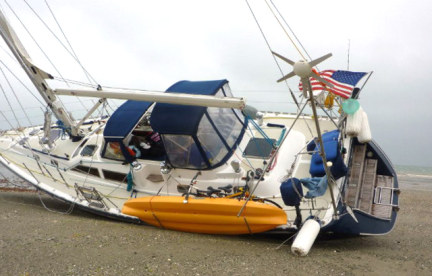
Lee shores are to be avoided. Latitude 38
But as mentioned, for modern sailors, the concept of a lee shore can be confusing. As a kid, I remember having a heated argument with my brother on the subject when we were moored in a snug cove while a gale howled over the island we were tucked behind. He remarked something about how great it was to be protected by a lee shore. I said, “That's not a lee shore, it's a windward shore.”
“What?” he responded. “That's a dang lee shore. The windward shore is the other one – where, you know, the wind is.”
There were many more No-its-not's and Yes-it-is's before Dad finally intervened and – ever the diplomat – pointed out that we were both right. From the island point of view, we were indeed off its lee shore. However, from the boat point of view, we were hunkered down behind a windward shore, because, in relation to the boat, the shore was to windward.
I couldn't have been more than 10 or 12 at the time, but I still remember being miffed that my brother could be even half-right. I've since learned to give him some leeway.